

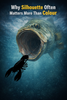
Why Silhouette Often Matters More Than Colour in Bass Fishing
, 5 min reading time
, 5 min reading time
When anglers talk about lure colour, the conversation usually starts with shade—green pumpkin or black, more flake or less, a touch more brown or blue. In the package, those differences are obvious.
Underwater, fish often don’t get that level of detail first.
They receive the bait as a signal. And in many real conditions, that signal starts with silhouette—the outline a bait creates against its background.
Before a fish can “judge colour,” it has to detect the bait at all. It has to separate it from water, sky, bottom, weeds, shadow, glare, and movement. If the bait isn’t reading clearly, swapping one similar shade for another usually doesn’t change much.
Silhouette isn’t “anti-colour.” It’s just priority.
Colour often matters more after the bait is already readable.
Anglers think in fine detail. Fish often react in simpler terms:
Is something there?
Can it be tracked?
Does it stand out enough to commit?
Does it look easy to intercept?
That first read is usually not about tiny colour nuance. It’s about whether the bait creates a usable outline.
In clear, bright, shallow water, fish may have time and detail—so subtle differences can matter more. But in everyday conditions—stained water, mixed light, depth, cloud cover, wind chop, shade, or pressure—the signal compresses. Fish are more likely to respond to:
outline
contrast
how cleanly the bait separates
how easy it is to follow
That’s why silhouette often does more work than colour.
Many people hear “silhouette” and think one thing: black.
Black can be effective, but silhouette is really about readability. A bait can create a strong silhouette without being the darkest option, as long as its profile stays clear in the conditions.
Silhouette strength changes with:
light (less light = less detail = outline matters more)
clarity (dirtier water = fine colour differences fade faster)
depth (colour separation drops, contrast carries more)
background (weeds, rock, mud, open water, shade lines)
movement (clean profiles track better through motion)
A better question than “Is this colour darker?” is:
“Does this bait create a cleaner outline in this situation?”
Silhouette moves up the priority list in very common conditions:
Low light (dawn/dusk, heavy cloud, shade lines)
Stained / dirty water
Deeper presentations
Busy backgrounds (weeds, timber, rock transitions, dock shade)
Fast decision windows (reaction bites, short tracking time)
These are not rare edge cases. This is everyday fishing.
Before asking “Is this the right colour?”, ask whether the fish can read the bait clearly.
A practical order:
Can the fish find it easily?
If not, a tiny shade change is usually too small—signal needs to change.
Does the outline hold against the background?
Some baits look great in hand but disappear against weeds, mud, glare, or broken light.
If it’s already readable, then refine colour nuance.
Once the signal is clear, smaller colour tweaks can matter more.
Also: when bites slow down, colour is often not the first fix. Adjusting fall rate, pause, angle, depth, placement can change how the bait is seen more than micro-shades ever will.
First fix the signal. Then refine the colour.
If many situations are won by visibility, contrast, and outline first, then a colour lineup doesn’t need endless tiny variations. It needs a few colours that create meaningfully different signals.
That’s why a tighter range can fish better:
less overlap
faster decisions
cleaner learning
more repeatable patterns
That isn’t limitation. It’s discipline.
Colour is detail. Silhouette is the signal.
Choose the bait the fish can read clearly first.
Then worry about finer colour differences.
Read the water. Cut the noise.

Subscriber pricing: C$1 off / pack.